
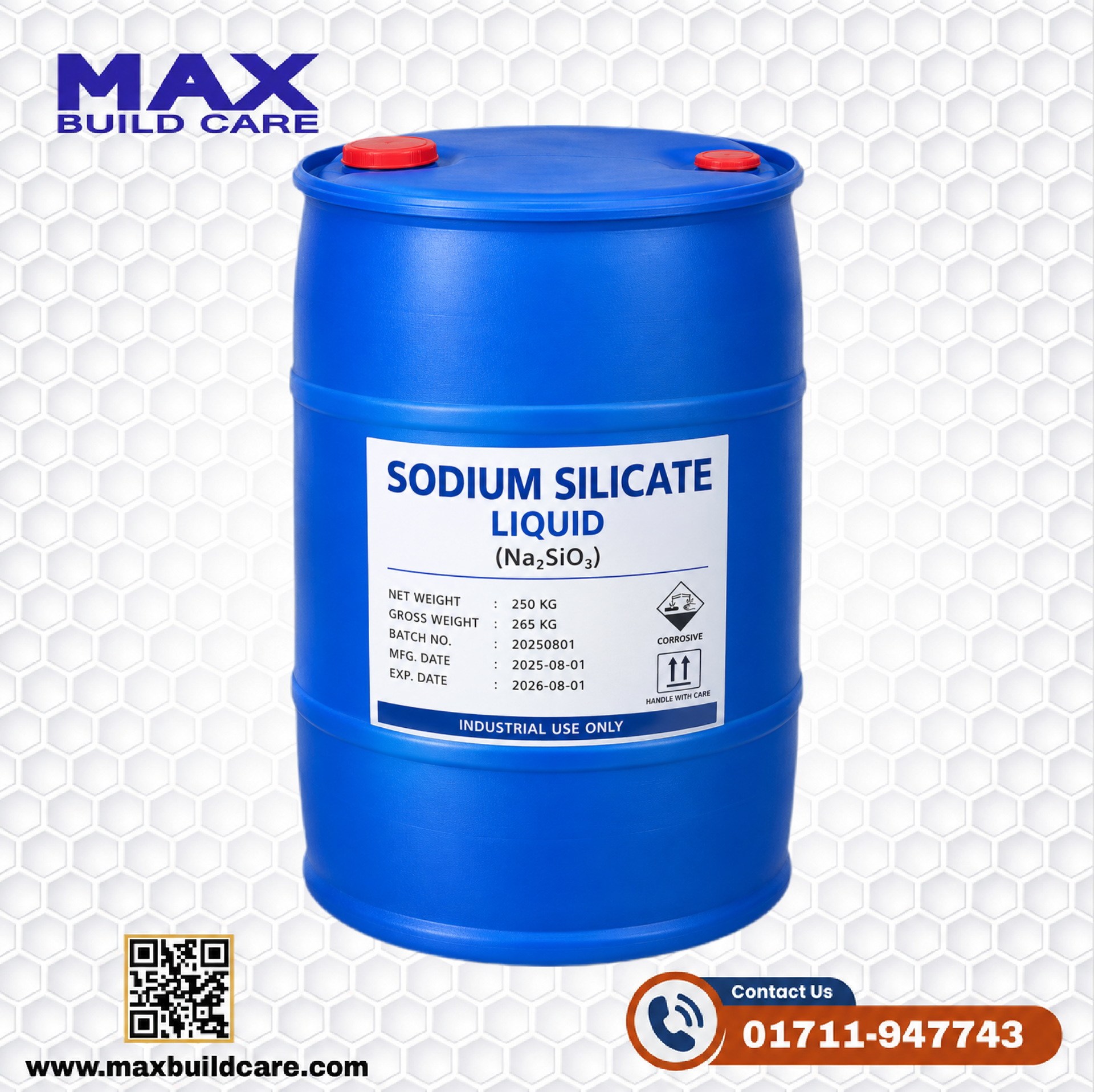
Description
Sodium Silicate – Versatile Industrial Binder, Adhesive & Alkaline Chemical
Sodium Silicate is a versatile inorganic chemical compound widely used across construction, detergent manufacturing, ceramics, foundry, paper, water treatment, refractory, and various industrial processing applications. Commonly known as Water Glass, Sodium Silicate is available in both liquid and solid forms and can be manufactured with different silica-to-sodium oxide ratios according to specific application requirements.
Its excellent binding properties, alkalinity, chemical stability, and ability to form hard, durable films make Sodium Silicate an important raw material for numerous industrial processes.
What is Sodium Silicate?
Sodium Silicate is a family of inorganic compounds generally represented by the chemical formula Na₂O·nSiO₂, where n represents the silica-to-sodium oxide ratio. Depending on the formulation and manufacturing process, it may be supplied as a clear to slightly colored liquid, glassy solid, or powder.
Liquid Sodium Silicate is commonly referred to as Water Glass. It is typically supplied as an aqueous solution and can be adjusted for different concentrations and modulus requirements.
The physical and chemical properties of Sodium Silicate vary depending on concentration, modulus, grade, and manufacturing specifications. Therefore, the appropriate grade should always be selected according to the intended application.
Key Features and Benefits
Excellent Binding Properties
Sodium Silicate can act as an effective inorganic binder. It can develop strong bonding characteristics when used with suitable materials, making it valuable in foundry, refractory, construction, and ceramic applications.
Strong Alkalinity
Sodium Silicate provides an alkaline environment and can be used as an alkaline processing agent in various industrial formulations.
Good Adhesion
Its adhesive properties make it useful for bonding selected porous and inorganic materials. It is used in applications where an inorganic binder or adhesive is preferred.
Film Formation
When properly formulated and processed, Sodium Silicate can form a hard, durable inorganic film or structure, contributing to surface protection and material binding.
Versatile Industrial Performance
Different grades and ratios allow Sodium Silicate to be adapted to a wide range of industrial processes, from detergent production to foundry binder systems and construction materials.
Major Industrial Applications
Sodium Silicate is widely used in:
- Detergent and cleaning products
- Construction materials
- Cement and concrete applications
- Refractory materials
- Foundry applications
- Ceramic manufacturing
- Welding electrode manufacturing
- Paper and pulp processing
- Water treatment
- Mineral processing
- Adhesives and binders
- Silica and chemical manufacturing
- Industrial cleaning formulations
- Soil stabilization and selected civil engineering applications
Sodium Silicate in Detergent Manufacturing
Sodium Silicate is an important component in certain detergent and cleaning formulations. It can contribute alkalinity, assist cleaning performance, and help control the formulation environment.
It may also provide useful effects related to corrosion protection and processing characteristics, depending on the detergent formulation and other ingredients.
The required Sodium Silicate grade, concentration, and modulus should be selected based on the formulation requirements.
Construction and Cement Applications
Sodium Silicate is used in selected construction and cement-related applications because of its binding and chemical properties.
It can be incorporated into certain formulations for surface treatment, hardening, dust reduction, and specialized construction materials. Sodium Silicate may also be used in selected repair and sealing systems where an inorganic chemical solution is required.
Its suitability depends on the specific construction system, substrate, exposure conditions, and desired performance.
Foundry Industry
One of the important industrial applications of Sodium Silicate is as an inorganic binder in foundry processes.
In suitable foundry systems, Sodium Silicate can be combined with sand and hardened using an appropriate curing process to produce molds or cores. The binder system can provide the required strength for casting operations while offering an inorganic alternative to certain organic binder systems.
Foundry performance depends on the Sodium Silicate modulus, concentration, sand characteristics, hardening method, and process conditions.
Refractory and Ceramic Applications
Sodium Silicate can function as a binder in selected refractory and ceramic formulations. It can help bind mineral and refractory particles and contribute to the formation of a stable structure after suitable curing or heating.
It may be used in selected refractory repair materials, ceramic products, and specialty inorganic formulations.
Water Treatment Applications
Sodium Silicate is also used in certain water treatment and industrial water-processing applications. Depending on the treatment process, it may assist with corrosion control, stabilization, or other chemical conditioning functions.
The correct grade and dosage must be determined based on water chemistry and the specific treatment objective.
Paper and Pulp Industry
In paper and pulp processing, Sodium Silicate can be used in selected bleaching and processing systems. Its alkaline properties and chemical characteristics can support specific stages of pulp treatment and processing.
The formulation and dosage depend on the type of pulp, bleaching system, and process conditions.
Application and Handling
Sodium Silicate should be handled according to the manufacturer’s technical data sheet and Safety Data Sheet (SDS).
For liquid Sodium Silicate, the product should be thoroughly mixed before use when required. Equipment and storage containers should be compatible with the product.
The correct dosage depends on the intended application, product concentration, modulus, and formulation. Industrial users should conduct appropriate trials before full-scale production.
Important Quality Parameters
When purchasing Sodium Silicate, important technical parameters may include:
- SiO₂ content
- Na₂O content
- SiO₂/Na₂O ratio or modulus
- Specific gravity
- Concentration
- Viscosity
- pH
- Appearance
- Insoluble matter
- Moisture content for solid grades
These specifications can vary depending on the intended application and supplier’s product grade.
Storage and Safety
Sodium Silicate should be stored in properly closed, compatible containers in a suitable dry and well-ventilated storage area. Liquid grades should be protected from contamination and unsuitable temperature conditions.
Appropriate personal protective equipment, including gloves and eye protection, should be used during handling. Avoid unnecessary contact with skin and eyes. In case of accidental exposure, follow the manufacturer’s SDS and appropriate first-aid procedures.
Packaging and Supply
Sodium Silicate can be supplied in different packaging formats depending on whether the product is liquid or solid and according to customer requirements. Industrial bulk supply can also be arranged where applicable.
The appropriate grade, concentration, modulus, packaging, and quantity should be specified according to the customer’s application.
Why Choose Sodium Silicate?
Sodium Silicate offers a combination of binding performance, alkalinity, adhesion, film-forming capability, and versatility, making it suitable for a broad range of industrial applications.
Its inorganic nature and availability in different grades allow manufacturers to select a formulation appropriate for specific production and processing requirements. From detergent manufacturing and foundry operations to construction, refractory, ceramic, paper, and water treatment applications, Sodium Silicate remains an important industrial chemical.
Conclusion
Sodium Silicate is a versatile and widely used inorganic chemical with applications across numerous industries. Available in liquid and solid forms and in different grades and modulus levels, it can serve as a binder, adhesive, alkaline agent, processing aid, and chemical conditioning material.
Proper selection of grade, concentration, modulus, and dosage is essential to achieve the desired performance. When correctly specified, stored, and handled, Sodium Silicate can provide reliable performance across construction, detergent, foundry, refractory, ceramic, paper, water treatment, and other industrial applications.
Reviews
There are no reviews yet.