
Cast-in-Situ Piling Service
৳ 80.00
Cast-in-Situ Piling Service is a specialized foundation construction method where reinforced concrete piles are cast directly at the project site after drilling the required borehole. This technique provides high load-bearing capacity, structural stability, and long-term durability for buildings, bridges, industrial structures, and infrastructure projects.
Cast-in-Situ Piling Service – Complete Foundation Engineering Description
Type: Deep Foundation Construction Service
Method: Bored Cast-in-Situ Reinforced Concrete Pile
Application: Residential Buildings, Commercial Complexes, High-Rise Structures, Bridges, Industrial Facilities, Infrastructure Projects
Cast-in-Situ Piling Service is one of the most reliable and widely used deep foundation construction methods in modern civil engineering. In this process, piles are constructed directly at the project site by drilling a borehole to the required depth, placing a reinforcement cage, and subsequently filling the hole with high-quality concrete. The resulting reinforced concrete pile transfers structural loads safely to deeper and stronger soil layers, ensuring long-term stability and structural integrity.
As urban development continues to expand and structures become taller and heavier, the demand for strong and dependable foundation systems has increased significantly. Cast-in-Situ Piling has become the preferred choice for engineers, architects, contractors, and developers due to its high load-bearing capacity, adaptability to different soil conditions, and proven performance in challenging construction environments.
Introduction to Cast-in-Situ Piling
The foundation is the most critical component of any structure. It transfers the entire load of the building to the ground and ensures overall stability throughout the lifespan of the structure.
When the upper soil layers are weak and unable to support heavy loads, deep foundations such as Cast-in-Situ piles are used to transfer the load to stronger strata located at greater depths.
Unlike precast piles, which are manufactured elsewhere and transported to the site, Cast-in-Situ piles are constructed directly on-site. This allows greater flexibility in pile diameter, depth, and design according to project requirements.
Working Procedure
The Cast-in-Situ piling process involves several carefully controlled steps:
Site Investigation
Before construction begins, a detailed soil investigation is conducted to determine soil characteristics, groundwater conditions, and required pile depth.
Borehole Drilling
A drilling rig is used to create a borehole of specified diameter and depth according to engineering design requirements.
Borehole Stabilization
Where necessary, bentonite slurry or temporary casing is used to stabilize the borehole walls and prevent collapse.
Reinforcement Cage Placement
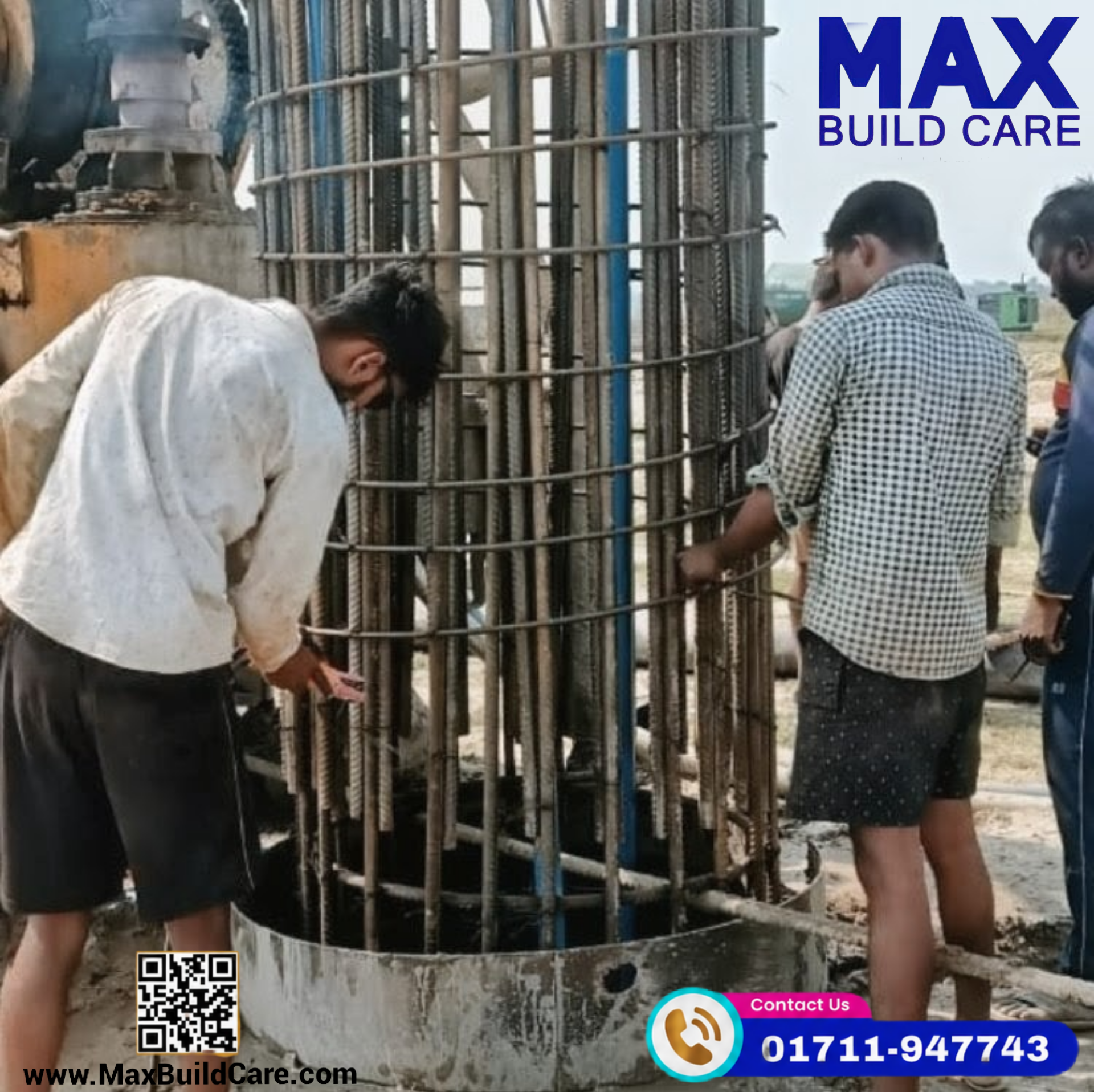
A fabricated steel reinforcement cage is lowered into the borehole to provide structural strength to the pile.
Concrete Placement
High-quality concrete is poured into the borehole using approved methods such as tremie pipe concreting to ensure continuous and defect-free placement.
Finishing and Curing
After concreting, the pile is allowed to cure and gain strength before being integrated into the foundation system.
Key Features and Benefits
High Load-Bearing Capacity
Cast-in-Situ piles are designed to support extremely heavy structural loads from buildings, bridges, and industrial facilities.
Excellent Structural Stability
The piles transfer loads safely to deeper and stronger soil layers, reducing settlement risks.
Flexible Design
Pile diameter and depth can be customized according to project-specific engineering requirements.
Suitable for Various Soil Conditions
The system performs effectively in clay, sand, silt, mixed soil, and other challenging ground conditions.
Reduced Noise and Vibration
Unlike driven piles, Cast-in-Situ piling generates minimal vibration and noise, making it ideal for urban and populated areas.
Long Service Life
Properly designed and constructed piles provide decades of reliable structural support.
Applications
Cast-in-Situ Piling is widely used across various sectors of the construction industry.
Residential Buildings
- Multi-storey apartments
- Residential towers
- Housing projects
- Villas and luxury homes
Commercial Buildings
- Shopping malls
- Office complexes
- Hotels
- Hospitals
- Educational institutions
Industrial Projects
- Factories
- Warehouses
- Power plants
- Manufacturing facilities
Infrastructure Development
- Bridges
- Flyovers
- Highways
- Railway structures
- Ports and marine facilities
Importance of Bentonite in Cast-in-Situ Piling
Bentonite plays a crucial role in bored piling operations.
Functions of Bentonite Slurry
- Stabilizes borehole walls
- Prevents soil collapse
- Controls groundwater intrusion
- Facilitates drilling operations
- Produces cleaner boreholes
High-quality Sodium Bentonite Powder, such as Ashapura PILOGEL, is commonly used to prepare bentonite slurry for piling applications.
Quality Control Measures
To ensure safe and durable pile construction, strict quality control procedures are followed:
- Soil testing and analysis
- Verification of borehole depth and diameter
- Reinforcement inspection
- Concrete quality testing
- Slurry property monitoring
- Integrity testing after pile construction
These measures ensure compliance with engineering standards and project specifications.
Advantages Over Conventional Foundations
Compared to shallow foundations, Cast-in-Situ piles offer several significant advantages:
- Greater load-bearing capacity
- Reduced differential settlement
- Improved structural safety
- Better performance in weak soil conditions
- Suitable for high-rise construction
- Enhanced resistance to lateral loads
These advantages make Cast-in-Situ piling a preferred foundation solution for modern construction projects.
Safety and Environmental Considerations
Modern piling operations are conducted with strict adherence to safety and environmental standards.
Safety Practices
- Use of certified equipment
- Trained operators and engineers
- Proper site supervision
- Compliance with construction safety regulations
Environmental Benefits
- Reduced vibration impact
- Lower noise levels
- Minimal disturbance to nearby structures
- Efficient use of construction materials
Conclusion
Cast-in-Situ Piling Service is a highly effective and dependable deep foundation solution used in residential, commercial, industrial, and infrastructure projects worldwide. By constructing reinforced concrete piles directly within drilled boreholes, this method provides exceptional load-bearing capacity, structural stability, and long-term durability.
Its adaptability to various soil conditions, minimal vibration, flexible design capabilities, and proven engineering performance make it one of the most trusted foundation systems in modern construction. For projects requiring a strong, safe, and durable foundation, Cast-in-Situ Piling remains the preferred choice of engineers, contractors, and developers.
Service Provider: Max Build Care
Specialized in Foundation Engineering, Piling Solutions & Construction Support Services