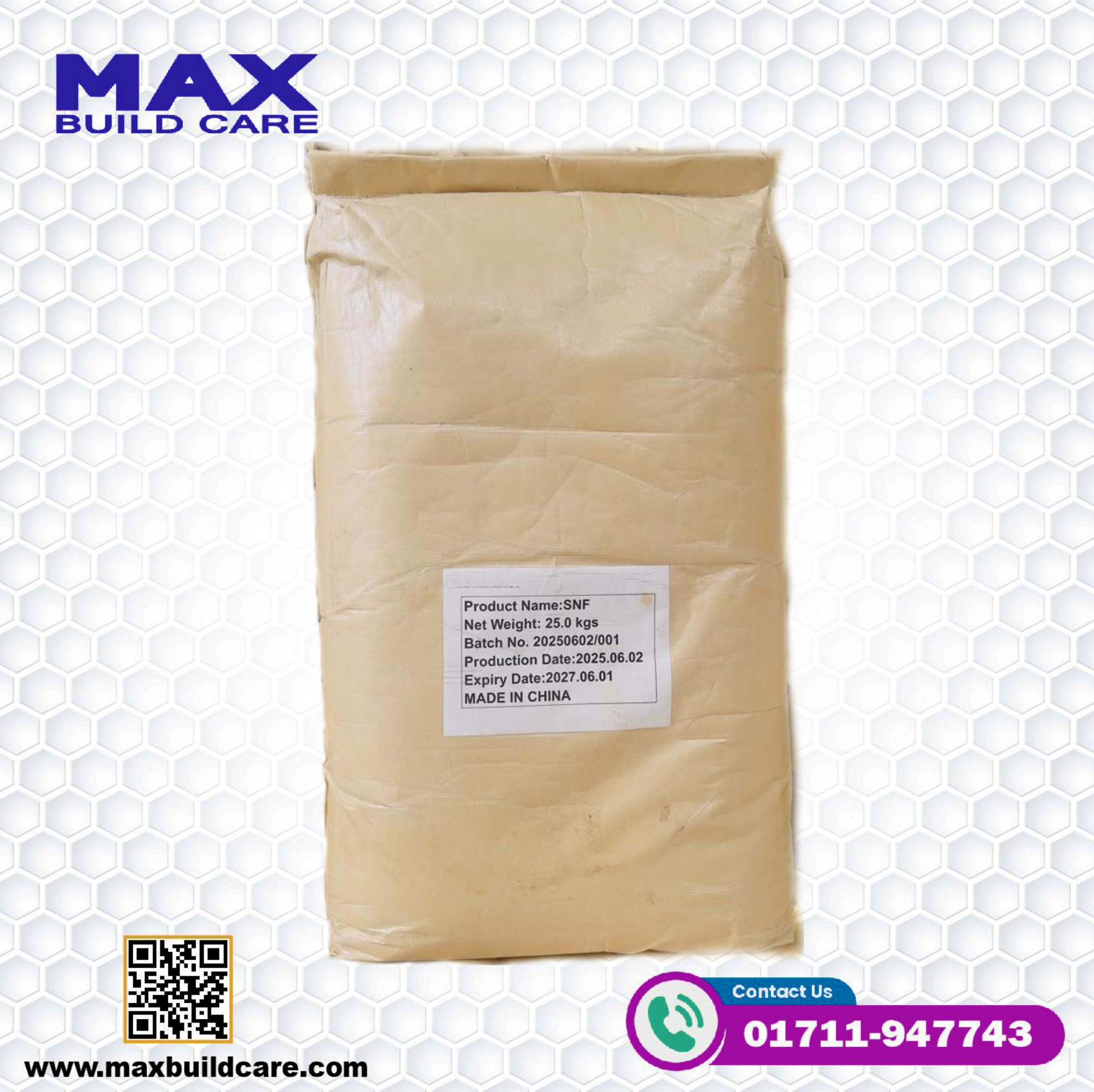
Sulphonated Naphthalene Formaldehyde (SNF) C₁₀H₇SO₃Na is a high-performance superplasticizer widely used in concrete admixtures to significantly improve workability, reduce water demand, and enhance strength. It disperses cement particles efficiently, ensuring smooth flow, faster setting control, and stronger, more durable concrete for modern construction applications.
Sulphonated Naphthalene Formaldehyde (SNF) is a highly effective synthetic polymer-based superplasticizer, widely used in the construction and industrial chemical sectors. Known for its excellent dispersing ability, SNF plays a crucial role in enhancing the workability, strength, and durability of concrete and mortar. It helps improve concrete flow without increasing water content, making it one of the most efficient water-reducing agents in modern construction technology.
Chemically, SNF is produced through the sulfonation of naphthalene, followed by condensation with formaldehyde. The typical structural repeating unit of SNF is represented as C₁₀H₇SO₃Na, though the complete polymeric structure is longer and more complex. This sulfonated polymer carries strongly negative charges, allowing it to effectively disperse cement particles through an electrostatic mechanism. As a result, cement particles repel each other, reducing flocculation and improving fluidity.
—
Key Chemical and Physical Properties
Chemical Name: Sulphonated Naphthalene Formaldehyde
Chemical Formula (Structural Unit): C₁₀H₇SO₃Na
Appearance: Brownish-yellow to dark-brown powder or liquid
Solubility: Easily soluble in water
pH (powder solution): 7–9
Moisture Content: Typically <10% in powder form
Ionic Nature: Anionic
Density: 0.5–0.75 g/cm³ (powder), 1.2–1.25 g/mL (liquid)
These characteristics make SNF extremely stable, easy to store, and suitable for blending into various admixture formulations.
—
How SNF Works in Concrete
SNF acts primarily as a superplasticizer and water-reducing agent. When added to concrete, it performs the following functions:
1. Enhanced Cement Particle Dispersion
The negative charges on SNF molecules prevent cement particles from clumping together. This leads to a uniform dispersion of cement, allowing water to work more effectively.
2. Significant Water Reduction
SNF can reduce mixing water by 18–25% without compromising workability. This improves concrete density, strength, and durability.
3. Increased Workability and Flow
It enables smooth, high-slump concrete without adding extra water. This is essential for pumpable concrete, high-performance concrete, and low-cement ratio mixes.
4. Improved Early and Final Strength
By reducing water content and improving compaction, SNF enhances both early-age strength and long-term compressive performance.
5. Better Finishing Quality
Improved flow and reduced segregation lead to smooth, defect-free surfaces with excellent finishing characteristics.
—
Major Applications of SNF
SNF is one of the most widely used admixtures in concrete technology. Its main applications include:
1. Ready-Mix Concrete (RMC)
SNF significantly improves flowability and pumpability, ensuring consistent quality of large-scale RMC operations.
2. Precast Concrete
Faster setting time, high early strength, and reduced water content make SNF ideal for precast elements such as slabs, beams, and columns.
3. High-Strength Concrete
SNF supports the production of M40, M50, M60 and higher grades by enabling low water-cement ratios.
4. Infrastructure Projects
Used in bridges, dams, tunnels, marine structures, highways, and massive foundations where durability is a key requirement.
5. Mortar and Plaster Additives
Provides improved workability and reduces water demand in masonry mortar, plaster, and grouts.
6. Industrial Applications
SNF is also used as a dispersant in ceramics, pigments, gypsum boards, textile dyeing, and agrochemicals, due to its strong dispersion properties.
—
Advantages of SNF
Excellent water reduction capability
Boosts workability without compromising strength
Enhances early and long-term compressive strength
Improves pumpability for large construction projects
Reduces segregation and bleeding
Compatible with most cement types
Economical and highly efficient compared to other plasticizers
Improves surface finish and durability of concrete
These benefits make SNF a preferred choice among engineers, ready-mix plants, and construction companies.
—
Storage and Handling
Store in a cool, dry place away from moisture.
Keep bags or liquid drums sealed tightly.
Avoid exposure to direct sunlight.
Powder form should be kept away from water to avoid premature activation.
SNF is non-toxic and environmentally safe when used as directed.
—
Conclusion
Sulphonated Naphthalene Formaldehyde (SNF) is a high-performance, cost-effective superplasticizer with exceptional water-reducing and dispersion properties. Its ability to significantly enhance workability, increase strength, improve durability, and optimize cement efficiency makes it indispensable in modern concrete production and industrial applications. Whether used in ready-mix concrete, precast manufacturing, or high-strength construction projects, SNF delivers reliable performance, consistent quality, and lasting structural advantages. For industries seeking an economical yet powerful admixture solution, SNF remains one of the most trusted choices worldwide.