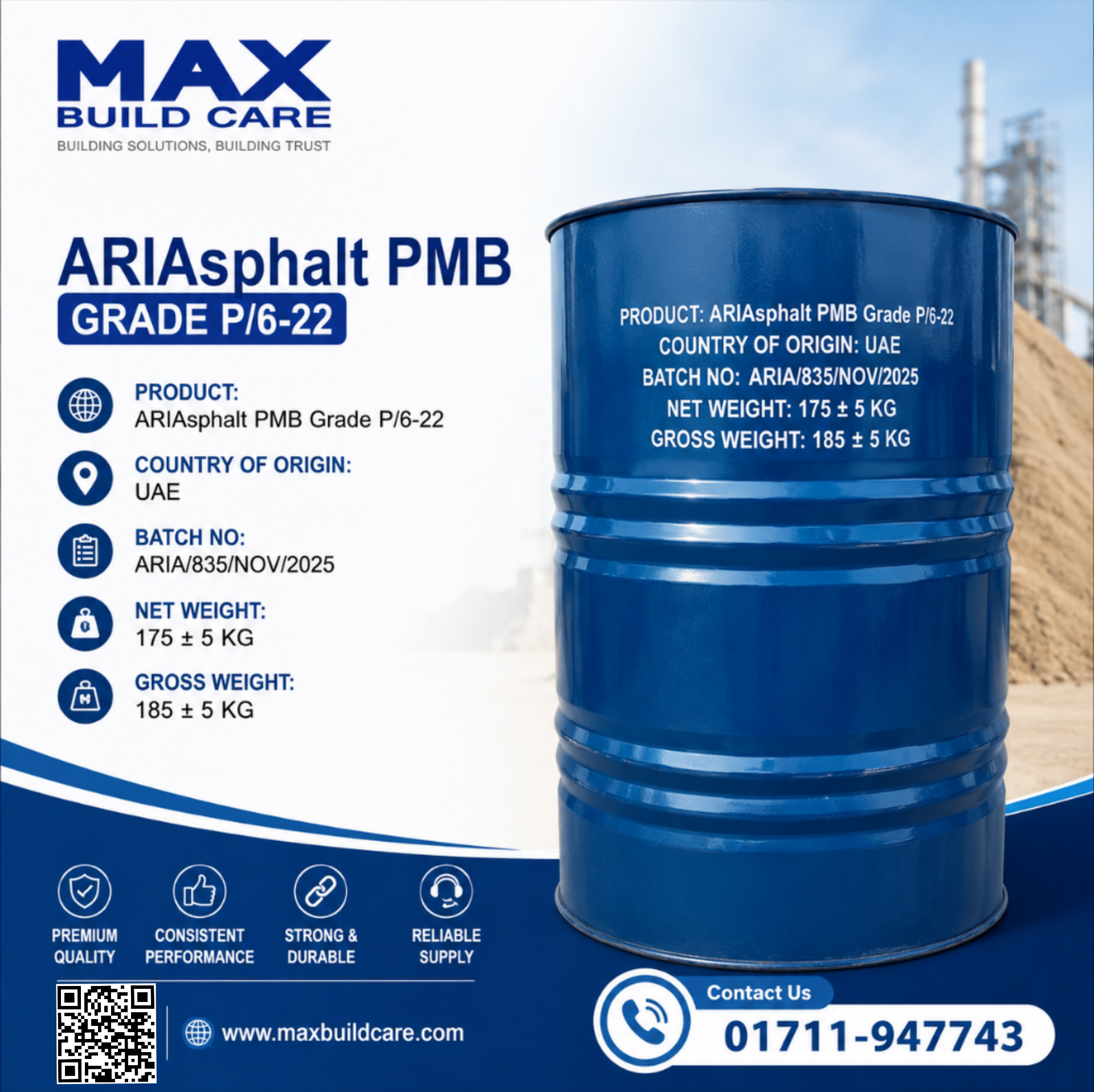
Polymer Modified Bitumen (PMB) price in Bangladesh
৳ 125,000.00
Polymer Modified Bitumen (PMB) is a high-performance bituminous binder modified with selected polymers to improve elasticity, flexibility, rutting resistance, fatigue resistance and temperature stability. It is widely used in highways, bridges, expressways, airport pavements and heavy-traffic roads, where superior durability and long-term pavement performance are required.
Polymer Modified Bitumen (PMB) – Complete Industrial Description
Product Name: Polymer Modified Bitumen (PMB)
Product Type: High-Performance Polymer-Modified Bituminous Binder
Base Material: Petroleum Bitumen + Selected Polymer Modifiers
Appearance: Black to Dark Brown, Highly Viscous Bituminous Material
Physical Form: Viscous Binder
Main Applications: Asphalt Concrete, Highways, Bridges, Expressways, Airport Pavements, Heavy-Traffic Roads & Pavement Rehabilitation
Polymer Modified Bitumen (PMB) is a high-performance bituminous binder produced by modifying conventional paving-grade bitumen with carefully selected polymers. The modification process significantly improves the binder’s elasticity, flexibility, rutting resistance, fatigue resistance, temperature stability and overall durability.
PMB is particularly valuable in modern road construction where pavement is exposed to heavy traffic loads, repeated wheel loading, high temperatures, temperature fluctuations and demanding environmental conditions. Compared with conventional paving bitumen, polymer modification can provide improved resistance to permanent deformation and cracking, helping asphalt pavements maintain their structural and functional performance for longer periods.
PMB is widely used in highways, expressways, bridges, airport runways, urban roads, heavy-duty industrial roads and other infrastructure projects where high-performance asphalt pavement is required.
Chemical Composition and Structure
Polymer Modified Bitumen consists primarily of:
- Petroleum-derived paving bitumen
- Polymer modifiers
- Selected additives, depending on the PMB grade
Common polymer modification systems include SBS (Styrene-Butadiene-Styrene) and other elastomeric or plastomeric polymers. The exact polymer type and concentration depend on the required performance grade and application.
Basic Composition:
Bitumen + Polymer Modifier + Performance Additives
During manufacturing, the polymer is incorporated into the hot bitumen under controlled temperature and high-shear mixing conditions. This creates a modified binder system in which the polymer significantly changes the rheological and mechanical behaviour of the original bitumen.
The resulting PMB can exhibit improved elastic recovery, temperature susceptibility, resistance to deformation and resistance to fatigue compared with conventional bitumen.
Key Properties
Polymer Modified Bitumen offers a range of important performance characteristics:
- Excellent rutting resistance
- Improved elastic recovery
- Enhanced flexibility
- Improved fatigue resistance
- Better resistance to permanent deformation
- Improved temperature stability
- Better resistance to thermal cracking
- Improved adhesion with suitable aggregates
- Higher resistance to repeated traffic loading
- Improved pavement durability
- Better resistance to ageing
- Suitable for heavy-duty pavement applications
- Improved resistance to water-related damage when properly designed
- Excellent performance over a wider temperature range
These properties make PMB an important binder for high-performance asphalt pavement systems.
Working Principle
The main purpose of polymer modification is to improve the mechanical and rheological behaviour of conventional bitumen.
Conventional bitumen can become softer at elevated temperatures and more brittle at low temperatures. Polymer modification helps control these temperature-dependent changes.
For example, elastomeric polymers such as SBS can create a polymer-rich network within the bitumen. This network can improve the binder’s elasticity and ability to recover after repeated traffic loading.
When heavy vehicles repeatedly pass over a road surface, the pavement experiences stress and deformation. A properly designed PMB binder can provide greater resistance to permanent deformation, helping reduce rutting and shoving.
At lower temperatures, appropriate polymer modification can also improve flexibility and reduce the tendency toward thermal cracking.
Major Industrial Applications
Highway Construction
PMB is widely used in high-speed and high-volume highways where pavement is subjected to continuous traffic loading.
It can be used in asphalt mixtures for:
- National highways
- Expressways
- Motorways
- Major arterial roads
- Heavy-traffic corridors
Its improved deformation resistance makes it particularly suitable for demanding highway applications.
Bridges and Flyovers
Bridge decks experience repeated dynamic loading, temperature variations and braking/acceleration stresses.
PMB can be incorporated into suitable asphalt mixtures used for bridge approaches, bridge decks and associated pavement structures to improve durability and resistance to deformation.
Airport Runways
Airport pavements require high-quality materials because aircraft impose substantial wheel loads and braking forces.
PMB can be used in appropriate asphalt mixtures for:
- Airport runways
- Taxiways
- Aprons
- Heavy-duty airport pavement
The enhanced deformation resistance of PMB can be beneficial in areas exposed to high loading.
Heavy-Traffic Roads
PMB is particularly suitable for roads carrying large numbers of heavy commercial vehicles.
Potential applications include:
- Industrial roads
- Port roads
- Container terminals
- Logistics areas
- Truck routes
- Mining access roads
Pavement Rehabilitation
PMB can also be used in pavement rehabilitation and resurfacing projects where improved durability is required.
It may be incorporated into asphalt overlays and wearing courses depending on the pavement design.
Advantages
Superior Rutting Resistance
One of the principal advantages of PMB is improved resistance to permanent deformation or rutting, particularly at elevated pavement temperatures.
Improved Elasticity
Polymer modification can provide greater elastic recovery, allowing the binder to recover more effectively after traffic-induced deformation.
Better Fatigue Resistance
Repeated traffic loading can eventually cause fatigue cracking. A properly formulated PMB can improve resistance to repeated loading and extend pavement service performance.
Improved Temperature Performance
PMB can provide improved performance across a broader range of temperatures compared with conventional paving bitumen.
Enhanced Durability
Improved resistance to deformation, fatigue and environmental stresses can contribute to longer-lasting asphalt pavement.
Better Heavy-Traffic Performance
PMB is especially beneficial for pavements subjected to frequent heavy axle loads and high traffic volumes.
Typical Technical Parameters
PMB is available in different performance grades, so technical specifications vary according to the manufacturer, polymer type and applicable standard.
| Property | Typical Description |
|---|---|
| Product Type | Polymer Modified Bitumen |
| Appearance | Black / Dark Brown Viscous Material |
| Base | Paving Bitumen + Polymer |
| Common Polymer | SBS or other selected polymers |
| Polymer Content | Grade-dependent |
| Penetration | Grade-dependent |
| Softening Point | Grade-dependent |
| Elastic Recovery | Grade-dependent |
| Viscosity | Grade-dependent |
| Flash Point | Grade-dependent |
| Ductility | Grade-dependent |
| Storage Stability | Grade-dependent |
| Application Temperature | Grade-dependent |
| Standards | ASTM / EN / IS or project-specific specification |
Important: PMB does not have one universal technical specification. For commercial supply, the exact grade—such as PMB 40, PMB 70 or another performance grade—must be confirmed before quoting technical values.
Manufacturing Process
The production of Polymer Modified Bitumen generally involves several controlled stages.
1. Selection of Base Bitumen
A suitable paving-grade bitumen is selected according to the required PMB grade.
2. Polymer Selection
A compatible polymer, commonly an elastomeric polymer such as SBS, is selected according to the required performance characteristics.
3. Heating
The base bitumen is heated to a controlled temperature suitable for polymer incorporation.
4. High-Shear Mixing
The polymer is dispersed into the hot bitumen using specialised high-shear mixing equipment.
5. Homogenisation
The mixture is processed until the polymer is uniformly dispersed and the required physical properties are achieved.
6. Quality Control
The finished PMB is tested for relevant properties such as penetration, softening point, viscosity, elastic recovery and other grade-specific parameters.
Asphalt Mix Applications
PMB can be used in different asphalt pavement layers depending on the project design.
Typical applications include:
- Wearing courses
- Surface courses
- Binder courses
- Stone Mastic Asphalt (SMA)
- Dense-graded asphalt
- Open-graded asphalt
- High-performance asphalt mixtures
The appropriate PMB grade should be selected based on traffic loading, climate, pavement structure, aggregate properties and engineering requirements.
Storage and Handling
PMB should be stored and handled according to the manufacturer’s technical recommendations.
General practices include:
- Store in clean and suitable heated tanks.
- Prevent contamination with water and foreign materials.
- Maintain the recommended storage temperature.
- Avoid unnecessary prolonged heating.
- Use suitable circulation or agitation where recommended.
- Prevent overheating.
- Ensure storage equipment is compatible with hot bituminous materials.
Storage temperature and maximum storage duration are grade- and manufacturer-dependent and should be confirmed from the relevant Technical Data Sheet.
Application Considerations
Proper handling and application are essential to achieving the expected performance of PMB.
Important considerations include:
- Correct PMB grade selection
- Proper aggregate selection
- Appropriate asphalt mix design
- Correct mixing temperature
- Proper transportation
- Correct paving temperature
- Adequate compaction
- Suitable pavement thickness
- Proper surface preparation
PMB should not simply be substituted for conventional bitumen without checking the asphalt mix design and project specification.
Safety and Handling
PMB is normally handled at elevated temperatures and therefore requires appropriate industrial safety procedures.
Safety Precautions:
- Wear suitable heat-resistant protective clothing.
- Use protective gloves.
- Wear appropriate eye and face protection.
- Avoid direct contact with hot bitumen.
- Keep water away from hot bitumen tanks and equipment.
- Ensure adequate ventilation.
- Follow approved hot-bitumen handling procedures.
- Consult the manufacturer’s latest Safety Data Sheet.
Hot bitumen can cause serious thermal burns, so trained personnel and appropriate protective equipment are essential.
Environmental Considerations
Polymer Modified Bitumen can contribute to longer-lasting pavement systems by improving resistance to deformation, cracking and repeated traffic loading.
Longer pavement service life can potentially reduce the frequency of major maintenance and resurfacing activities.
Nevertheless, PMB production and asphalt mixing require controlled heating and energy consumption. Responsible plant operation, energy management, emissions control and proper waste handling should therefore be maintained according to applicable environmental regulations.
Quality Control
Quality control is particularly important for PMB because polymer compatibility and dispersion have a major influence on performance.
Typical quality-control parameters may include:
- Penetration
- Softening point
- Elastic recovery
- Viscosity
- Ductility
- Flash point
- Storage stability
- Polymer content
- Temperature susceptibility
The exact testing requirements should be based on the specified PMB grade and applicable national or international standard.
Why Choose Polymer Modified Bitumen?
Polymer Modified Bitumen (PMB) provides a technically advanced alternative to conventional paving bitumen for demanding asphalt applications.
Its improved elasticity, deformation resistance, fatigue performance and temperature stability make it particularly suitable for heavy-traffic roads, highways, bridges, expressways, airport pavements and other critical infrastructure.
By selecting the appropriate PMB grade and combining it with a properly designed asphalt mixture, engineers can achieve improved pavement performance and potentially extend service life.
Conclusion
Polymer Modified Bitumen (PMB) is a high-performance bituminous binder produced by modifying conventional paving bitumen with selected polymers. The modification process improves important engineering properties such as elasticity, rutting resistance, fatigue resistance, flexibility and temperature stability.
PMB is widely used in highways, expressways, bridges, airport runways, urban roads, industrial roads and pavement rehabilitation projects, particularly where heavy traffic and demanding environmental conditions require enhanced pavement performance.
Its superior resistance to permanent deformation and repeated loading makes it an excellent choice for modern high-performance asphalt mixtures. When the correct PMB grade is selected and combined with proper aggregate quality, asphalt mix design, paving and compaction practices, it can contribute significantly to durable, reliable and long-lasting road infrastructure.
For commercial and engineering applications, the exact PMB grade, polymer type, technical parameters, application temperature and applicable standard should always be confirmed from the manufacturer’s latest Technical Data Sheet and the relevant project specification. :::