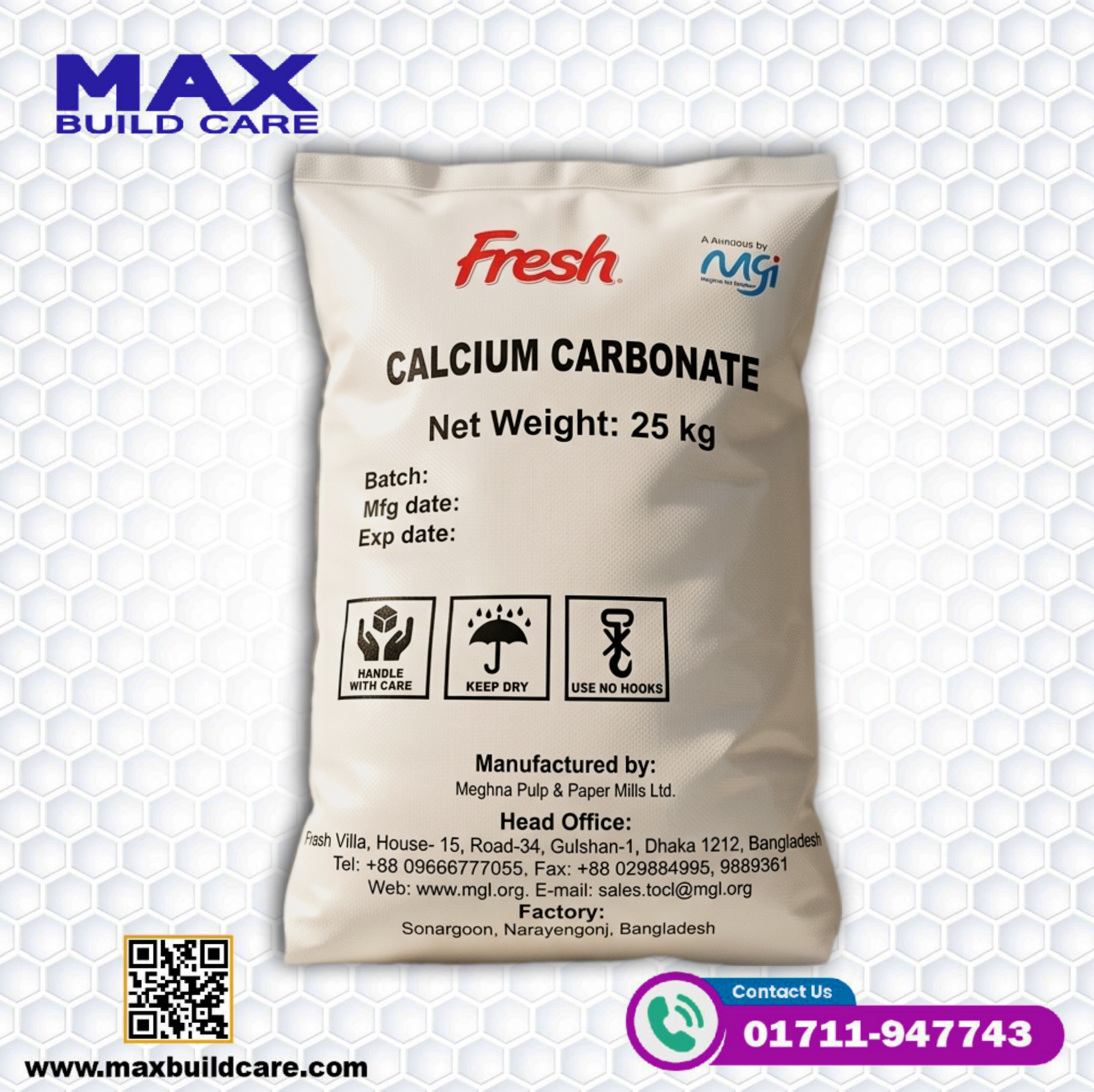
Calcium Carbonate is a widely used mineral compound found in limestone, marble, and chalk. It is commonly used in construction, paints, plastics, paper, and pharmaceuticals as a filler, whitening agent, and pH regulator, offering excellent durability and cost-effectiveness.
Chemical Formula: CaCO₃
Appearance: White powder (fine or granular)
Calcium Carbonate (CaCO₃) is one of the most widely used natural mineral compounds in the world, found in limestone, marble, and chalk deposits. Due to its high availability, low cost, and excellent functional properties, it plays a vital role in construction, plastics, paints, paper, pharmaceuticals, and many other industries. Its versatility, combined with consistent quality and performance, makes calcium carbonate an essential raw material in modern industrial applications.
Calcium carbonate occurs naturally and is extracted through mining processes. It is then processed into different grades such as Ground Calcium Carbonate (GCC) and Precipitated Calcium Carbonate (PCC), depending on the application requirements. These forms differ in particle size, purity, and production methods, allowing manufacturers to select the most suitable type for their needs.
Calcium carbonate is composed of calcium, carbon, and oxygen atoms arranged in a stable crystalline structure.
Chemical Formula: CaCO₃
It is chemically stable under normal conditions and exhibits alkaline properties. When exposed to high temperatures, it decomposes into calcium oxide (CaO) and carbon dioxide (CO₂), a reaction that is widely used in industrial processes such as lime production.
Calcium carbonate offers a wide range of beneficial properties:
These characteristics make it highly suitable for enhancing product performance while reducing production costs.
1. Ground Calcium Carbonate (GCC):
Produced by mechanically grinding natural limestone or marble. It is widely used as a filler in construction and industrial applications.
2. Precipitated Calcium Carbonate (PCC):
Manufactured through a chemical process, offering finer particle size and higher purity. It is used in high-end applications such as paper, pharmaceuticals, and coatings.
Construction Industry:
Calcium carbonate is used in cement, concrete, and mortar as a filler and performance enhancer. It improves strength, durability, and workability.
Paints and Coatings:
Used as a filler and extender to improve opacity, brightness, and surface finish.
Plastics Industry:
Acts as a reinforcing filler in PVC, polyethylene, and polypropylene products. It enhances stiffness, reduces cost, and improves processing.
Paper Industry:
Used as a coating pigment and filler to improve paper brightness, smoothness, and printability.
Pharmaceuticals:
Used as a calcium supplement and antacid in tablets and healthcare products.
Rubber Industry:
Improves strength, abrasion resistance, and processing performance.
Calcium carbonate can be easily incorporated into different formulations:
Calcium carbonate is typically supplied in 25 kg or 50 kg bags, as well as bulk packaging options. It should be stored in a dry and clean environment to prevent moisture absorption and contamination.
Calcium carbonate is generally safe and non-hazardous. However, fine dust may cause minor irritation. It is recommended to use protective masks and ensure proper ventilation during handling.
Calcium Carbonate (CaCO₃) is a versatile, cost-effective, and essential mineral widely used across multiple industries. Its excellent physical and chemical properties make it an ideal filler and performance enhancer in construction, plastics, paints, paper, and pharmaceuticals. With its high availability, environmental friendliness, and reliable performance, calcium carbonate continues to be a key material in modern industrial production and manufacturing processes.
+880 9638-076453
+8801711-947743
maxbuildcarebd@gmail.com
28 Kawran Bazar, Taj-Mention,Tejgaon, Dhaka-1215, Bangladesh.
Chunkutia Chowrasta,
South Keraniganj, Dhaka-1310, Bangladesh.
123/2 Jail Road,
South Keraniganj, Dhaka-1310, Bangladesh.