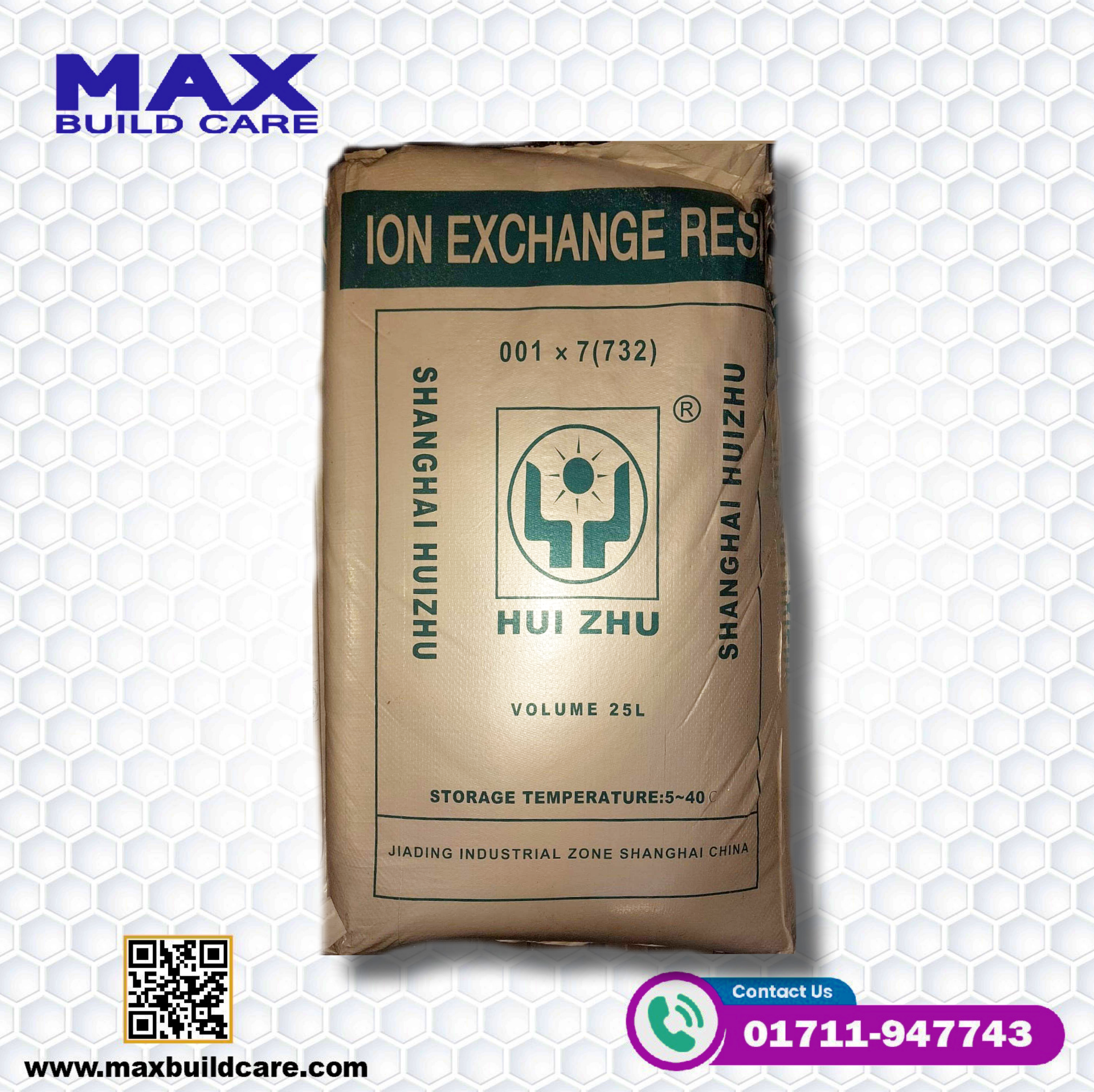
ION EXCHANGE RESIN
৳ 1.00
Ion Exchange Resin (Type: Cation/Anion, R–SO₃H / R–N⁺(CH₃)₃) is a high-performance polymer matrix containing active functional groups such as R–SO₃H (Cation Resin) and R–N⁺(CH₃)₃ (Anion Resin). It effectively removes dissolved ions from water through exchange reactions, ensuring high-purity water in industrial, commercial, and water-treatment applications. Widely used in demineralization, softening, wastewater treatment, and desalination systems.
Ion Exchange Resin is a highly functional polymer material widely used for water purification, softening, demineralization, and chemical processing. These resins are specially designed to remove unwanted ions from liquids and replace them with desirable ions through a reversible chemical exchange mechanism. Because of their high efficiency, strong durability, and selective ion-removal capacity, Ion Exchange Resins are used extensively in industrial, commercial, and laboratory applications.
Chemical Structure and Composition
Ion Exchange Resins are made from cross-linked polystyrene beads. These beads contain special functional groups that determine whether the resin will exchange cations or anions.
Cation Exchange Resins contain sulfonic acid groups (–SO₃H), which release hydrogen or sodium ions in exchange for calcium, magnesium, iron, and other positively charged ions.
Anion Exchange Resins contain amine or quaternary ammonium groups, which exchange hydroxide or chloride ions for sulfate, nitrate, silica, and other negatively charged ions.
This strong chemical structure provides high mechanical strength, excellent thermal stability, and long working life.
Working Principle
The working principle of Ion Exchange Resin is based on the ion exchange reaction, where undesirable ions in water attach to the resin beads and are replaced by harmless ions.
For example:
Hardness ions (Ca²⁺, Mg²⁺) are replaced by sodium (Na⁺).
Chloride (Cl⁻) or nitrate (NO₃⁻) is replaced by hydroxide (OH⁻).
As water passes through the resin bed, it becomes purified, softened, or completely demineralized depending on the application.
Types of Ion Exchange Resin
1. Cation Exchange Resin
Used for removing calcium, magnesium, iron, manganese, and other positively charged ions.
Commonly used in:
Water softening
Dealkalization
Pretreatment for boilers
2. Anion Exchange Resin
Used for removing chloride, sulfate, silica, bicarbonate, and organic anions.
Applications include:
Deionization
Demineralization
Wastewater treatment
3. Mixed Bed Resin
A blend of both cation and anion resins.
Widely used for:
Ultrapure water
Final polishing
Laboratory-grade water systems
Mixed bed resins deliver the highest purity levels.
Key Features and Advantages
High Purity Output: Produces soft, deionized, or ultrapure water.
Fast Ion Exchange Rate: Engineered bead structure ensures quick interaction with ions.
Excellent Chemical Durability: Resists acids, alkalis, and oxidizing agents to a high degree.
Regenerable: Can be restored multiple times using acid, caustic soda, or salt solutions.
Long Service Life: Strong cross-linking provides stability over long-term usage.
Customizable Grades: Available in various bead sizes, moisture contents, and functional group densities.
Industrial Applications
Ion Exchange Resin plays a crucial role in many industries, such as:
1. Water Treatment Industry
Used for water softening, boiler feedwater preparation, cooling tower water conditioning, and municipal water purification.
2. Power Plants
Produces high-purity water essential for steam generation and turbine protection.
3. Pharmaceuticals
Ensures contamination-free water required for drug formulation and laboratory processes.
4. Food and Beverage Industry
Used in sugar refining, beverage clarification, decolorization, and removal of undesirable ions.
5. Metal Recovery & Mining
Helps in selective separation and extraction of precious metals, heavy metals, and rare earth elements.
6. Petrochemical & Chemical Processing
Used in catalyst purification, fluid processing, and specialty chemical manufacturing.
Regeneration Process
Ion Exchange Resins gradually lose their exchange capacity as they absorb ions. To restore their efficiency, regeneration is done using appropriate chemicals:
Cation resins are regenerated using hydrochloric acid (HCl) or sulfuric acid (H₂SO₄).
Anion resins are regenerated with sodium hydroxide (NaOH).
This restores the resin to its original active state, allowing continuous use for long periods and reducing operational costs.
Storage and Handling
For long-term performance, the resins should be stored in airtight containers, protected from direct sunlight, heat, and dehydration. Maintaining moisture levels is essential to prevent bead cracking.
Conclusion
Ion Exchange Resin is an indispensable material in modern water treatment and industrial purification systems. With its superior ion-removal ability, high durability, and versatility, it ensures consistent water quality across multiple sectors. Whether for softening, demineralization, polishing, or selective ion separation, Ion Exchange Resin provides a reliable and efficient solution for achieving high-purity water and process optimization.