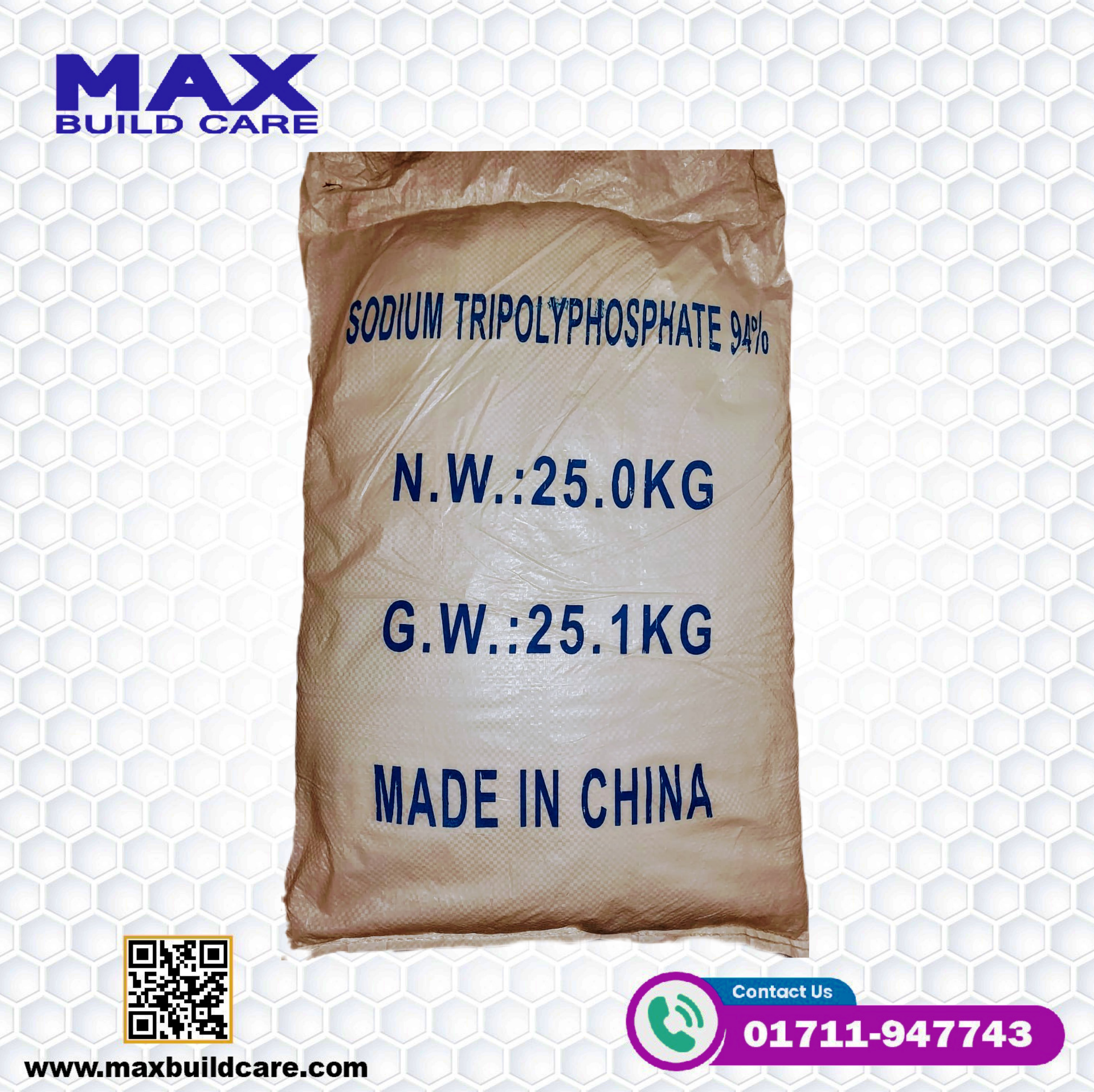
SODIUM TRIPOLYPHOSPHATE (STPP)
৳ 1.00
Sodium Tripolyphosphate (STPP, Na₅P₃O₁₀, 94%) is a high-purity inorganic phosphate widely used as a water softener, detergent builder, and emulsifying agent. It improves cleaning efficiency in laundry, dishwashing, and industrial cleaning, prevents scale formation, enhances dispersion of minerals, and stabilizes food and chemical formulations.
Sodium Tripolyphosphate (STPP, Na₅P₃O₁₀, 94%) is a high-purity inorganic phosphate widely recognized for its multifunctional properties in industrial, household, and food-grade applications. As a highly effective water softener, detergent builder, emulsifier, and sequestering agent, STPP is extensively used in detergent production, water treatment, food processing, ceramics, textiles, and various chemical manufacturing processes. Its superior performance, excellent solubility, and chemical stability make it a preferred ingredient in modern industrial and commercial formulations.
—
Chemical and Physical Properties
Chemical Formula: Na₅P₃O₁₀
Purity: 94% minimum
Appearance: White crystalline powder or granules
Solubility: Highly soluble in water
pH (1% aqueous solution): 9–10
Density: 2.53 g/cm³ (crystalline form)
Ionic Nature: Anionic
Moisture Content: Typically <1%
These properties ensure that STPP remains highly effective and versatile for diverse applications, delivering consistent results across industries.
—
Key Industrial Applications
1. Detergent Manufacturing
STPP is one of the most widely used detergent builders globally. Its primary role is to:
Soften hard water by binding calcium and magnesium ions
Enhance detergent efficiency and cleaning power
Prevent scale and soap scum formation on fabrics and surfaces
Improve solubility and dispersion of powders and liquids
It is used in laundry detergents, dishwashing powders, and industrial cleaning formulations, ensuring brighter, cleaner results with less effort.
—
2. Food Processing Applications
In the food industry, STPP serves as a sequestrant, emulsifier, stabilizer, and moisture retention agent. Its uses include:
Seafood processing: Maintains color, texture, and moisture in shrimp, fish, and crab
Meat and poultry: Prevents protein aggregation and improves water-holding capacity
Dairy products: Enhances texture and prevents separation in processed cheese and milk products
Beverages and sauces: Stabilizes solutions and prevents mineral precipitation
Food-grade STPP ensures compliance with international safety standards, making it essential for modern food processing.
—
3. Water Treatment
STPP acts as an effective sequestering and chelating agent in water treatment. By binding with calcium, magnesium, and other metal ions, it:
Prevents scale formation in boilers and industrial pipelines
Reduces corrosion in water systems
Enhances performance of cleaning and processing chemicals
Its use in industrial and municipal water systems ensures efficient operations and longevity of equipment.
—
4. Ceramics and Textiles
In the ceramics industry, STPP is used as a dispersant and deflocculant, improving the workability of clay and glaze suspensions. In textiles, it:
Stabilizes dye solutions
Prevents mineral precipitation in water used for dyeing
Improves color uniformity and fabric quality
These applications demonstrate STPP’s versatility beyond cleaning and food processing.
—
5. Chemical Industry
STPP is used as an intermediate in the synthesis of other phosphate compounds and chemical formulations. Its chelating and buffering properties make it a key ingredient in:
Industrial detergents
Metal treatment solutions
Electroplating chemicals
It supports precise chemical reactions by controlling ionic concentrations and reducing unwanted reactions caused by hard water or metal ions.
—
Advantages of Sodium Tripolyphosphate (STPP, 94%)
High purity ensures reliable performance in all applications
Strong water softening and sequestering ability
Highly soluble for fast dissolution and efficiency
Enhances cleaning, texture, and stability in food, detergents, and industrial formulations
Versatile across multiple industries
Cost-effective and widely available
Environmentally manageable when used according to guidelines
—
Handling and Storage
To maintain its high efficiency, STPP should be stored and handled properly:
Store in a dry, cool, ventilated area
Keep containers tightly sealed to avoid moisture absorption
Avoid contact with acids and strong oxidizing agents
Use standard PPE (gloves, masks, and goggles) when handling powder form
Proper storage ensures the product remains stable, free-flowing, and ready for use across all intended applications.
—
Conclusion
Sodium Tripolyphosphate (Na₅P₃O₁₀, 94%) is a versatile, high-performance, and indispensable chemical for modern industry. Its exceptional water-softening, emulsifying, chelating, and stabilizing properties make it a key ingredient in detergents, food processing, water treatment, ceramics, textiles, and chemical manufacturing. By improving efficiency, enhancing product quality, and ensuring consistent results, STPP delivers tangible benefits for manufacturers and industries worldwide. Its high purity, solubility, and stability ensure that it remains a cost-effective and reliable solution for a wide range of applications, establishing it as one of the most trusted inorganic phosphate compounds in industrial and commercial use.