
Description
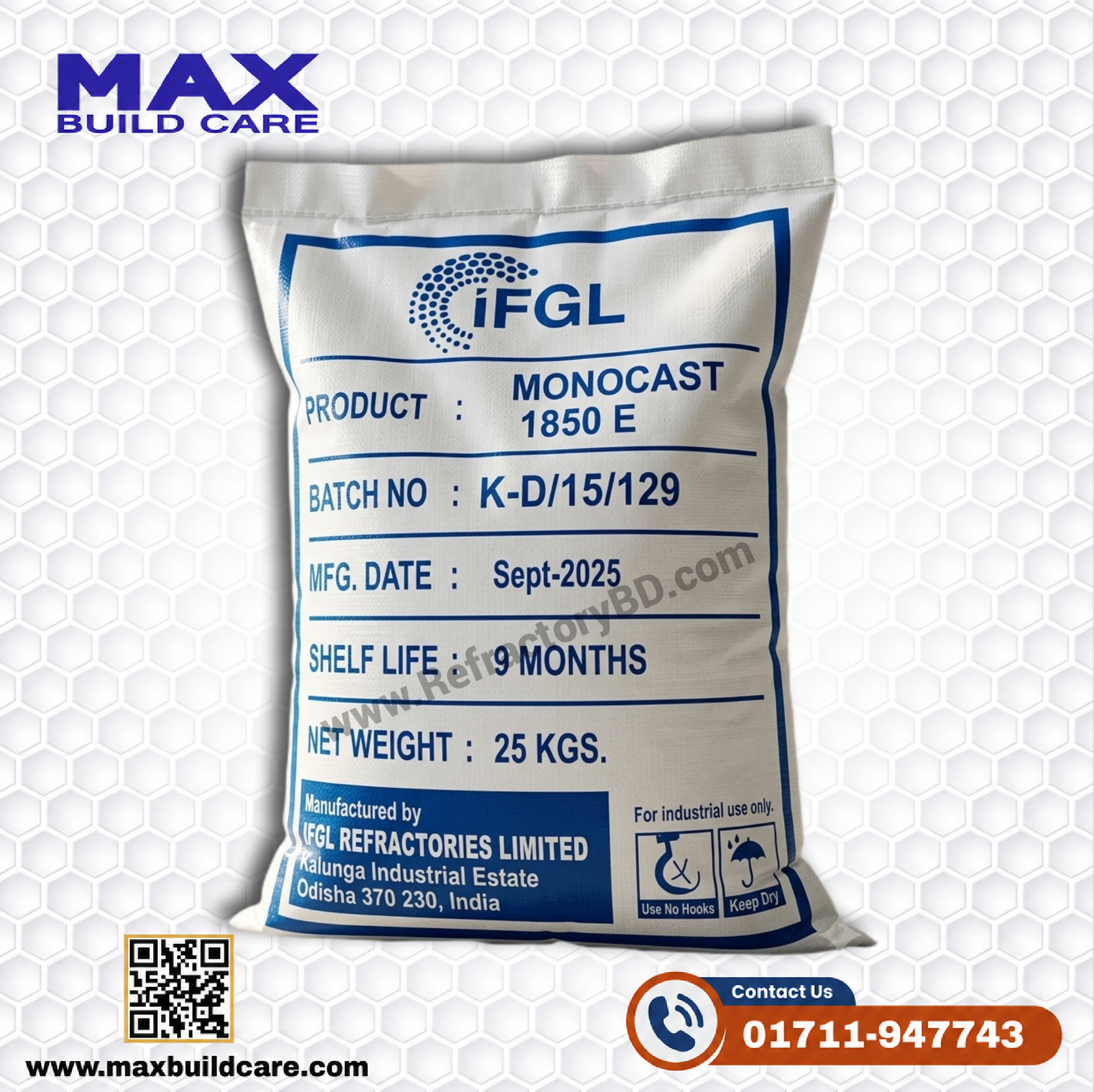
MONOCAST 1850 E – High Performance Refractory Castable
MONOCAST 1850 E is a high-temperature refractory castable designed for demanding industrial applications where excellent thermal resistance, mechanical strength, dimensional stability, and durability are required. It is suitable for the construction and repair of refractory linings exposed to severe heat and harsh operating conditions.
As a refractory castable, MONOCAST 1850 E is supplied as a dry, pre-formulated material that can be mixed with the recommended quantity of water and installed to create a dense and durable refractory lining. Its high-temperature performance makes it suitable for industrial furnaces, kilns, heaters, combustion chambers, and other thermal-processing equipment, subject to the manufacturer’s technical recommendations.
What is MONOCAST 1850 E?
MONOCAST 1850 E is a monolithic refractory material used to form protective linings in high-temperature industrial equipment. Unlike conventional refractory bricks, monolithic castables are installed directly at the required location and can be shaped around complex geometries, making them particularly useful for furnace repairs, equipment lining, and areas where conventional brick installation may be difficult.
The product is formulated using selected refractory aggregates, binders, and performance-enhancing components to provide a stable refractory structure after installation and proper curing/drying.
The “1850” designation indicates a product associated with high-temperature refractory service, while the exact classification, installation method, chemical composition, strength values, service temperature, and other technical parameters should be verified from the current manufacturer Technical Data Sheet (TDS).
Key Features and Benefits
High Temperature Resistance
MONOCAST 1850 E is designed for high-temperature applications where ordinary construction materials cannot withstand continuous thermal exposure. It helps protect the underlying equipment structure from intense heat.
Excellent Refractory Performance
The dense refractory structure provides resistance against severe thermal conditions and helps maintain the integrity of the lining during high-temperature operation.
Good Mechanical Strength
After proper installation, curing, and drying, the castable develops mechanical strength suitable for demanding industrial refractory applications. Correct installation practices are essential to achieve the specified performance.
Monolithic Construction
Because MONOCAST 1850 E is installed as a monolithic refractory lining, it can provide a continuous protective layer without the numerous individual joints associated with traditional refractory brickwork.
Suitable for Complex Shapes
Castable technology allows the material to be installed around various equipment geometries, corners, curves, and difficult-to-access areas, provided suitable formwork and installation procedures are used.
Useful for Repair and Maintenance
The product can be considered for refractory maintenance and repair work where damaged or worn refractory lining needs to be replaced or restored.
Typical Applications
MONOCAST 1850 E may be suitable for high-temperature refractory applications such as:
- Industrial furnaces
- Heat-treatment furnaces
- Kilns
- Heaters
- Combustion chambers
- Furnace floors
- Furnace walls
- Burner areas
- Hot zones
- Industrial boilers and thermal equipment
- Chimney and flue-related refractory areas
- Steel and metal processing facilities
- Foundry applications
- Cement and lime processing equipment
- Ceramic and mineral processing industries
- General industrial refractory maintenance
The exact application suitability should be confirmed against the manufacturer’s current technical data and the operating conditions of the equipment.
Installation Procedure
Proper installation is critical to the performance and service life of any refractory castable.
Before application, the installation area should be properly prepared. The existing surface must be sound, clean, and free from loose refractory material, dust, oil, grease, and other contaminants.
Suitable formwork should be installed where required to achieve the desired lining thickness and geometry.
MONOCAST 1850 E should be mixed strictly according to the manufacturer’s recommended procedure. Only the specified quantity of clean water should be added. Excessive water can negatively affect the density, strength, porosity, and overall performance of the finished refractory lining.
Mechanical mixing is generally preferred to achieve a uniform and homogeneous mixture. The mixed castable should be placed and compacted properly to minimize voids and ensure good contact with the substrate or anchoring system.
Depending on the installation method, vibration or other appropriate compaction techniques may be required. Avoid unnecessary addition of water during installation.
Curing and Drying
Curing and controlled drying are extremely important for refractory castables. After installation, the material should be cured and dried according to the manufacturer’s recommended procedure.
Rapid heating or uncontrolled temperature increase can cause excessive internal steam pressure and may result in cracking or explosive spalling. Therefore, the refractory lining should be dried gradually using a controlled heating schedule appropriate for the product and installation thickness.
The exact curing, drying, and heat-up schedule should always be taken from the latest MONOCAST 1850 E technical documentation and adjusted for actual site conditions.
Advantages of Monolithic Refractory Castable
Monolithic refractory castables provide several practical advantages over conventional refractory brick systems. They can reduce the number of joints, accommodate complex geometries, simplify certain repair operations, and provide a continuous refractory lining.
For maintenance teams, castable systems can also be useful for restoring damaged refractory areas without necessarily replacing large sections of brickwork.
When the correct product is selected and professionally installed, a monolithic refractory lining can provide reliable protection against heat, thermal cycling, abrasion, and other operating stresses.
Quality and Technical Considerations
The performance of MONOCAST 1850 E depends not only on the material itself but also on correct storage, mixing, installation, curing, drying, and furnace heat-up procedures.
Before placing an order for a specific industrial project, users should evaluate:
- Operating temperature
- Maximum service temperature
- Chemical environment
- Abrasion exposure
- Thermal cycling
- Required lining thickness
- Installation method
- Drying and heat-up requirements
- Mechanical and thermal requirements
- Compatibility with existing refractory materials
For critical applications, consultation with the refractory manufacturer’s technical team is recommended.
Storage and Handling
MONOCAST 1850 E should be stored in a dry, covered location protected from rain, moisture, and direct water exposure. Bags should remain sealed until required for use and should preferably be stored on pallets above the floor.
Moisture contamination can adversely affect dry refractory materials. Therefore, damaged, opened, or moisture-affected bags should be evaluated before use and handled according to the manufacturer’s recommendations.
Supply in Bangladesh
MAX BUILD CARE provides refractory and construction material solutions for industrial plants, factories, contractors, maintenance teams, and engineering projects throughout Bangladesh.
We can assist customers with MONOCAST 1850 E based on project requirements, including product availability, quotation, packaging, technical documentation, and bulk supply arrangements.
For large industrial projects, customers are encouraged to provide details such as application area, equipment type, operating temperature, required quantity, lining thickness, and installation method so that the appropriate refractory solution can be selected.
Conclusion
MONOCAST 1850 E is a high-performance monolithic refractory castable intended for demanding high-temperature industrial applications. Its castable form allows the creation of continuous refractory linings and makes it suitable for various furnace, kiln, heater, foundry, and industrial maintenance applications.
The best performance and service life are achieved when the material is stored correctly, mixed with the recommended water quantity, properly installed and compacted, adequately cured, and subjected to a controlled drying and heat-up schedule.
For technical specifications, exact service temperature, chemical composition, installation thickness, strength values, and other product-specific parameters, users should always refer to the latest manufacturer-approved TDS and installation guidelines for MONOCAST 1850 E.
Reviews
There are no reviews yet.