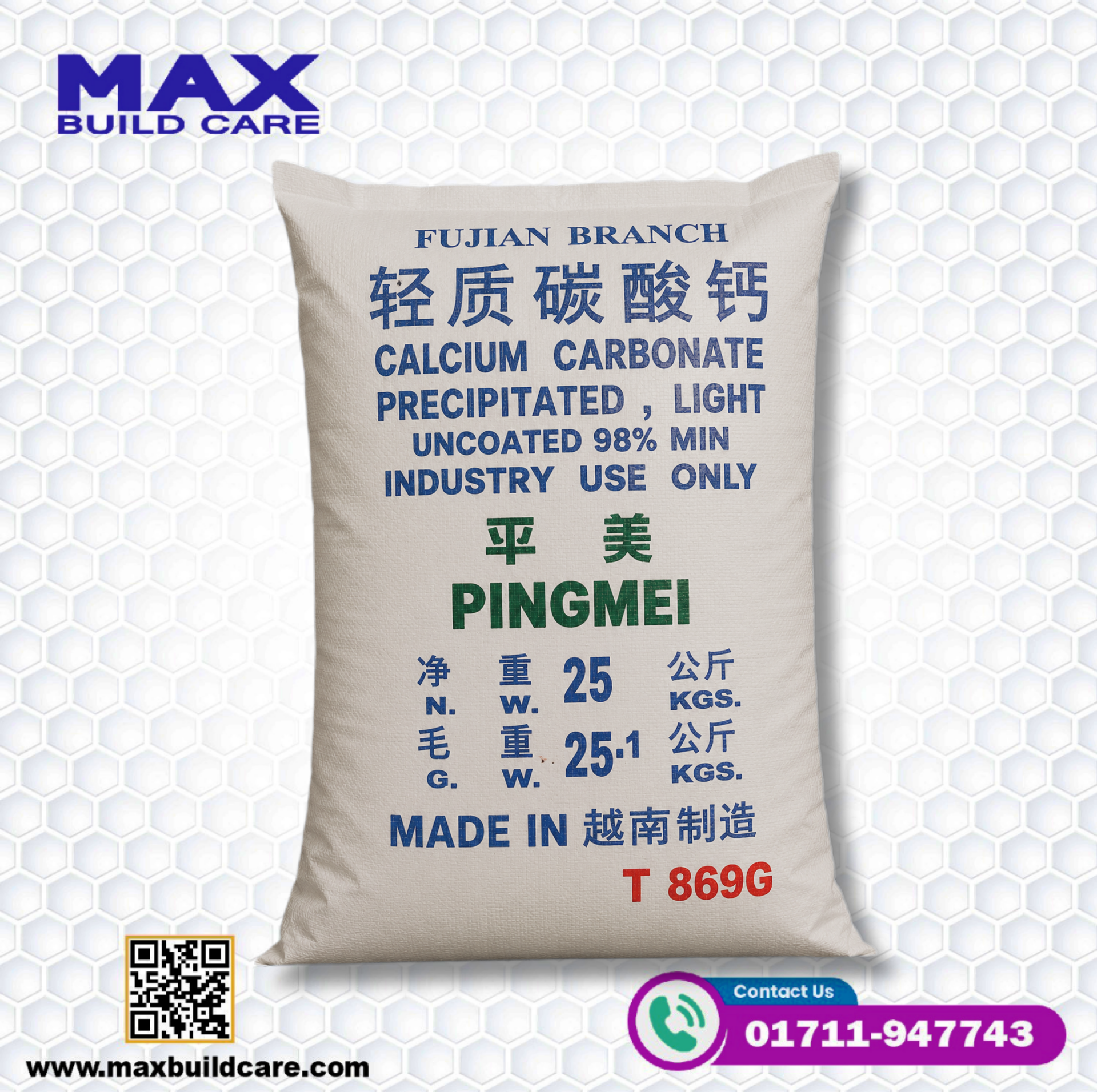
Uncoated Precipitated Calcium Carbonate (PCC) Powder
৳ 1.00
Uncoated Calcium Carbonate Precipitated Light (PCC), Calcium Carbonate, is a high-purity white fine powder used as a cost-effective filler. It improves brightness, smoothness, and strength in plastics, paints, rubber, paper, and PVC industries, offering excellent dispersion and consistent performance in various industrial applications.
Uncoated Calcium Carbonate (Precipitated Light) – Complete Industrial Description
Chemical Formula: CaCO₃
Appearance: Ultra-fine white powder
Uncoated Calcium Carbonate (Precipitated Light) is a high-purity, finely processed mineral widely used as a functional filler in plastics, paints, rubber, paper, pharmaceuticals, and various industrial applications. It is produced through a controlled chemical precipitation process, resulting in extremely fine particle size, high brightness, and excellent uniformity.
Unlike coated grades, this product is uncoated PCC (Precipitated Calcium Carbonate), making it highly compatible with water-based systems and ideal for applications where surface treatment is not required. Its superior whiteness, controlled particle size, and consistent quality make it a preferred choice in modern manufacturing industries.
Chemical Composition and Structure
Precipitated Calcium Carbonate is composed of calcium, carbon, and oxygen in a stable crystalline form.
Chemical Formula:
CaCO₃
It is chemically stable, non-toxic, and insoluble in water. The controlled precipitation process allows precise control over particle size and morphology, resulting in improved performance in industrial applications.
Key Properties
Uncoated PCC offers several important industrial properties:
- High whiteness and brightness
- Ultra-fine particle size
- Excellent dispersion in formulations
- High purity and consistency
- Low oil absorption
- Improved opacity and smoothness
- Cost-effective filler material
These properties make it suitable for a wide range of industries requiring high-quality filler performance.
Manufacturing Process
Precipitated Calcium Carbonate is produced through a chemical process involving limestone:
Production Steps:
- Calcination of limestone to produce calcium oxide (CaO)
- Hydration to form calcium hydroxide (Ca(OH)₂)
- Carbonation using carbon dioxide (CO₂)
- Controlled precipitation of calcium carbonate
- Filtration, drying, and micronization
This controlled process ensures uniform particle size, high purity, and excellent brightness.
Major Industrial Applications
Plastic Industry
Used as a filler in PVC, polyethylene, and polypropylene products to improve stiffness, reduce cost, and enhance processing efficiency.
Paint and Coating Industry
Acts as an extender pigment to improve opacity, whiteness, and surface smoothness in water-based and solvent-based paints.
Paper Industry
Improves brightness, printability, and surface quality in paper production.
Rubber Industry
Enhances mechanical strength, wear resistance, and processing performance.
Adhesives and Sealants
Improves viscosity control and filler performance.
Pharmaceuticals (Limited Applications)
Used as a calcium supplement and excipient in controlled formulations.
Advantages
- High brightness and whiteness
- Excellent dispersion in water-based systems
- Fine and uniform particle size
- Improves mechanical and optical properties
- Cost-effective functional filler
- Environmentally safe and non-toxic
Technical Parameters (Typical)
- Purity: 98%–99%
- CaCO₃ Content: ≥ 98%
- Moisture Content: ≤ 0.5%
- Particle Size: Ultra-fine (sub-micron to micron range)
- Whiteness: High brightness grade
Working Principle
Uncoated PCC works primarily as a functional filler and extender. Its ultra-fine particles fill gaps within polymer, paint, or paper matrices, improving density, opacity, and surface finish. Because it is uncoated, it disperses easily in water-based systems, making it highly suitable for emulsions and aqueous formulations.
Packaging and Storage
- Supplied in 25 kg bags or jumbo bags
- Should be stored in a dry, cool environment
- Protect from moisture and contamination
- Keep bags tightly sealed to maintain quality
Safety and Handling
Uncoated calcium carbonate is non-toxic and safe to handle under normal industrial conditions.
Precautions:
- Avoid inhalation of fine dust
- Use masks and gloves during handling
- Ensure proper ventilation in working areas
Conclusion
Uncoated Calcium Carbonate (Precipitated Light) is a high-quality, ultra-fine mineral widely used as a versatile filler in plastics, paints, paper, rubber, and chemical industries. Its excellent brightness, fine particle size, and superior dispersion properties make it an essential raw material in modern manufacturing. With consistent quality, cost efficiency, and broad industrial compatibility, it remains one of the most important functional fillers in global industrial applications.